
Viral no longer means local.
If your content is available in only one language, you limit its potential reach across global audiences. The creator economy is worldwide, but language barriers still slow growth.
AI-powered dubbing addresses this challenge.
Modern AI-Powered Dubbing, natural text-to-speech, and accurate lip-sync now produce voiceovers that sound almost human. What once felt robotic now feels real.
This is not just a production upgrade; it’s a growth strategy.
With the AI dubbing market projected to reach $2.9 billion by 2033, creators and businesses are adopting it fast.
AI-powered dubbing is becoming a core part of global content distribution strategies.
Whether you run a YouTube channel, create online courses, manage marketing campaigns, or build a streaming platform, AI-powered dubbing helps you reach new audiences without re-recording content.
In this guide, you’ll learn the key benefits of AI dubbing, how it compares to traditional methods, and why it’s becoming essential for global growth.
AI-Powered Dubbing Explained
AI-powered dubbing is a technology that translates and replaces the original voice in a video with a new voice in another language automatically and at a lower cost than traditional dubbing.
You can translate a single video into several languages using AI-Powered Dubbing without having to record it again.
It works using four smart systems:
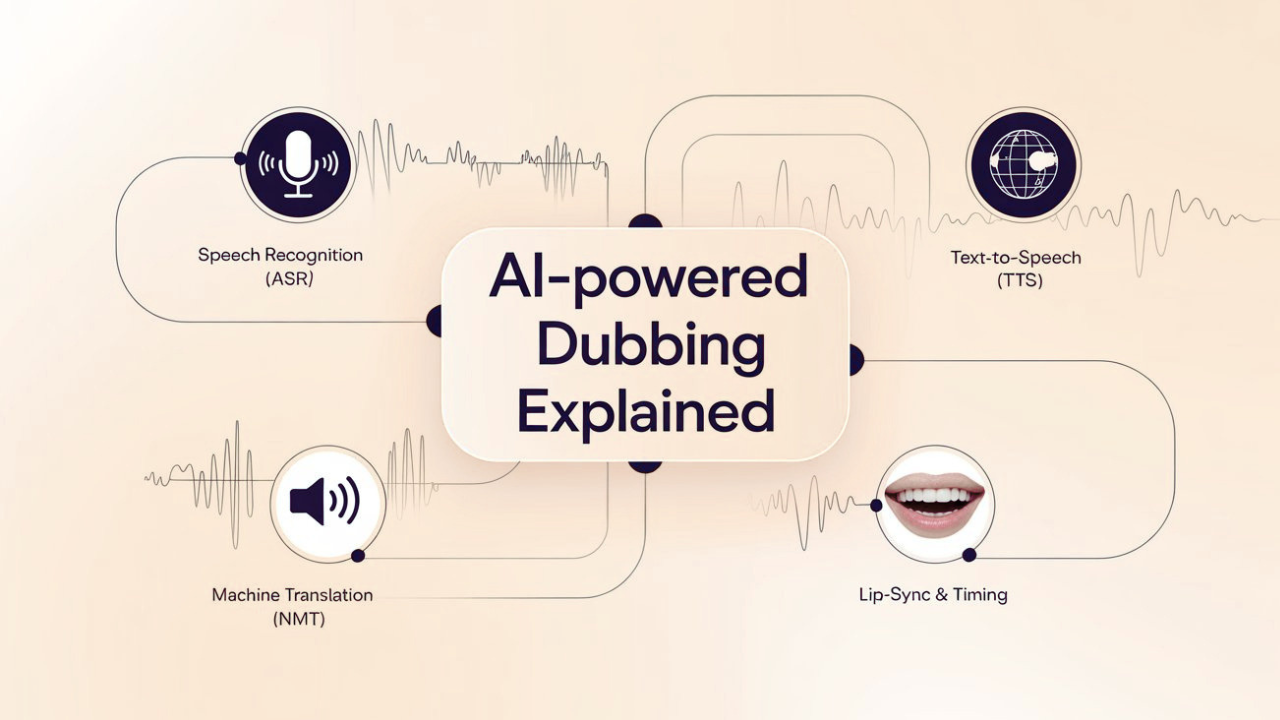
➕ Speech Recognition (ASR) – Converts spoken audio into text accurately.
➕ Machine Translation (NMT) – Translates the text while keeping the original meaning and tone.
➕ Text-to-Speech (TTS) – Generates a natural AI voice in the new language.
➕ Timing & Lip-Sync — Aligns the speaker's lip motions with the new voice.
Adoption of AI-Powered Dubbing Across Industries
• YouTube creators and automation channel operators expanding into new regions
• E-learning platforms localizing courses for students worldwide
• SaaS companies dubbing product demos, tutorials, and onboarding videos
• Marketing teams producing multilingual ad campaigns at speed
• Independent filmmakers and documentary producers seeking distribution
• News organizations broadcasting in multiple languages simultaneously
10 Benefits of AI-Powered Dubbing for Global Content
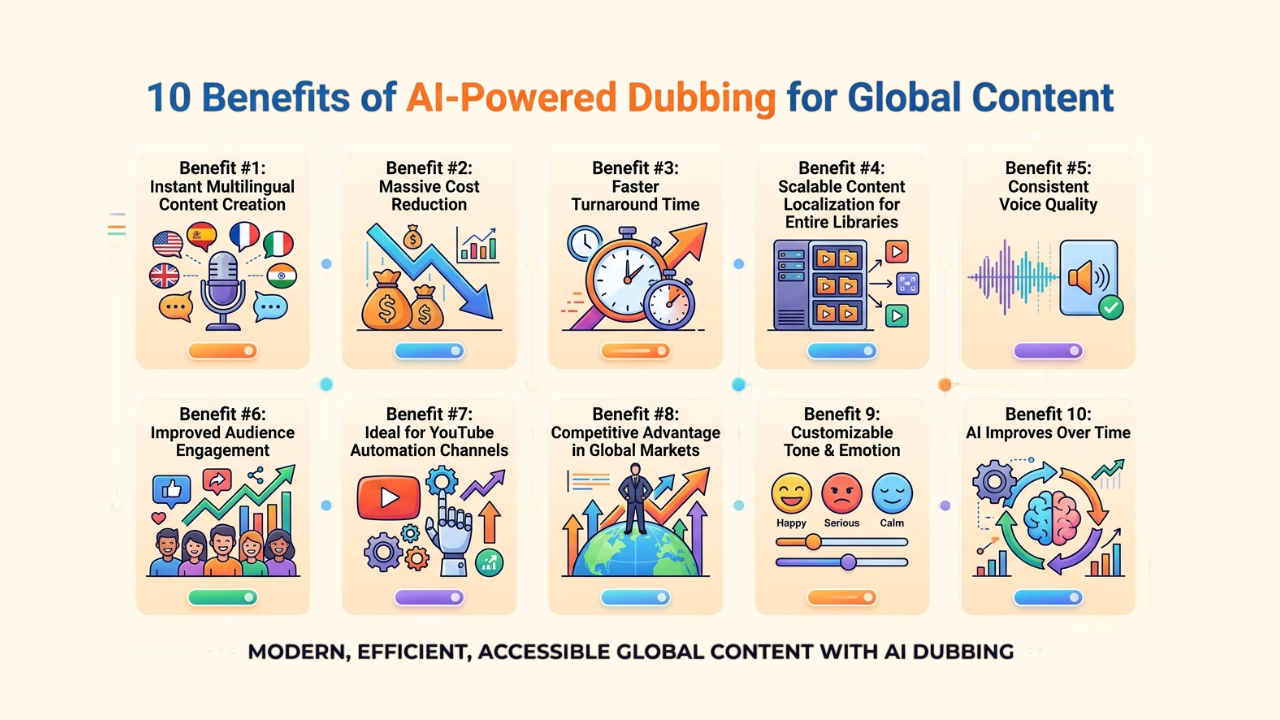
Benefit #1: Instant Multilingual Content Creation
Why keep your video available in just one language?
With AI-powered dubbing, you can turn one video into many language versions in just a few clicks. You don’t need to record again or change the original video. Your content is automatically translated by the Vidscribe tool, which also adds voiceovers that sound natural.
Your message can now reach people in Spanish, Hindi, Arabic, Portuguese, French, and many other languages, all from the same video.
Benefit #2: Massive Cost Reduction
Multiple voice actors, studios, and post-production teams are no longer necessary thanks to AI-powered dubbing. Conventional dubbing is infamously costly, frequently ranging from $500 to $5,000 for a 5-minute video. With AI dubbing, this is reduced by over 90%.
➕ Traditional Dubbing
Cost for a 5-minute video: $500 – $5,000
Turnaround time: 2–7 days
Scalability: Limited by human talent
➕ AI-Powered Dubbing
Cost for a 5-minute video: $10 – $30
Turnaround time: Less than 1 hour
Scalability: Virtually infinite
Benefit #3: Faster Turnaround Time
As shown in the pointer, traditional dubbing takes 2- 8 weeks per language. But with AI-powered dubbing, that is reduced to 1–24 hours, even for long-form videos. That speed directly impacts growth and revenue.
- Publish multilingual news while the story is still trending
- Launch global marketing campaigns without delay
- Capitalize on viral YouTube topics before interest drops
Instead of waiting weeks for localization, you can release content across multiple markets the same day.
Benefit #4: Scalable Content Localization for Entire Libraries
AI-powered dubbing not only localizes a single video, but also scales across your entire catalog. What this enables:
- Dub entire video libraries into multiple languages at once
- Scale effortlessly for eLearning, SaaS, and media platforms
- Maintain multilingual consistency as your content grows
AI makes sure your worldwide reach grows along with your content library. With the aid of Vidscribe, which uses high-fidelity AI to transcribe, translate, and redub existing videos into a variety of languages.
Benefit #5: Consistent Voice Quality
AI-powered dubbing with voice cloning solves this.
Once your voice or your spokesperson’s voice is cloned, every translated version maintains the same tone, energy, and personality. Whether your audience is in Spain, Japan, or Germany, they experience the same brand voice.
Familiarity strengthens audience relationships. Consistency strengthens brands. Key advantages:
- Clone your voice once and deploy it globally
- Eliminate tonal inconsistencies across markets
- Protect and scale your brand identity in every language
Benefit #6: Improved Audience Engagement
Dubbed videos consistently generate higher watch time, lower drop-off rates, and stronger emotional engagement than subtitled versions.
Subtitles split attention. Viewers must read and watch at the same time, which is especially difficult on mobile screens where text is small. Dubbing removes that cognitive load, allowing audiences to focus fully on visuals and storytelling.
For monetized creators, this directly impacts revenue. Higher retention leads to:
- More ads served
- Better CPM performance
- Stronger algorithm signals
Not only does AI-powered dubbing increase reach, but it also enhances the metrics that determine revenue and growth.
Benefit #7: Ideal for YouTube Automation Channels
Running a faceless YouTube channel? AI-powered dubbing helps you scale fast.
Turn one script-based video into multiple language versions without extra filming. Each version can grow its own audience and earn separate ad revenue based on local CPM rates. Why it works:
- Expand into new languages easily
- Manage multiple regional channels from one content source
- Increase revenue by targeting higher-CPM markets
One video. Multiple channels. More income.
Benefit #8: Competitive Advantage in Global Markets
Most video creators still publish only in English. That leaves massive opportunities in underserved language markets, and the benefits of AI-powered dubbing make expansion fast and affordable.
First-mover advantage in new language markets can be difficult for later entrants to overcome.
Key advantages:
- Enter high-growth language markets before competitors
- Build early algorithm authority in regional audiences
- Establish your brand as a leading voice across multiple regions
Benefit 9: Customizable Tone & Emotion
You have complete control over the sound of your voice with AI-powered dubbing tools. Whether the tone is formal, friendly, calm, or lively, you can adjust it to suit your brand.
Also, fine-tune emotion for each part of your video, so every moment feels right. Once set, save your voice style and use it across all content for consistency.
What you can do:
- Choose your preferred tone
- Match emotion to each section
- Save and reuse voice settings
To get help with a clear voice, you can use Vidscribe, which uses natural speech technology and local language creation to produce voiceovers. Right emotion. Consistent brand.
Benefit 10: AI Improves Over Time
As you get closer to the end, you'll notice that AI-powered dubbing is constantly evolving. The voice, translation, and lip-sync models are all regularly updated. As the system learns from more data and feedback, quality, accuracy, and emotion improve.
Because VidScribe enables a single video to reach a worldwide audience and receive regular updates, the tool you use today will sound better in the future without requiring additional effort from you.
Why it matters:
- Quality and accuracy improve over time
- Early users gain long-term advantage
- Your content grows stronger with each update
AI Dubbing vs. Traditional Dubbing: Side-by-Side
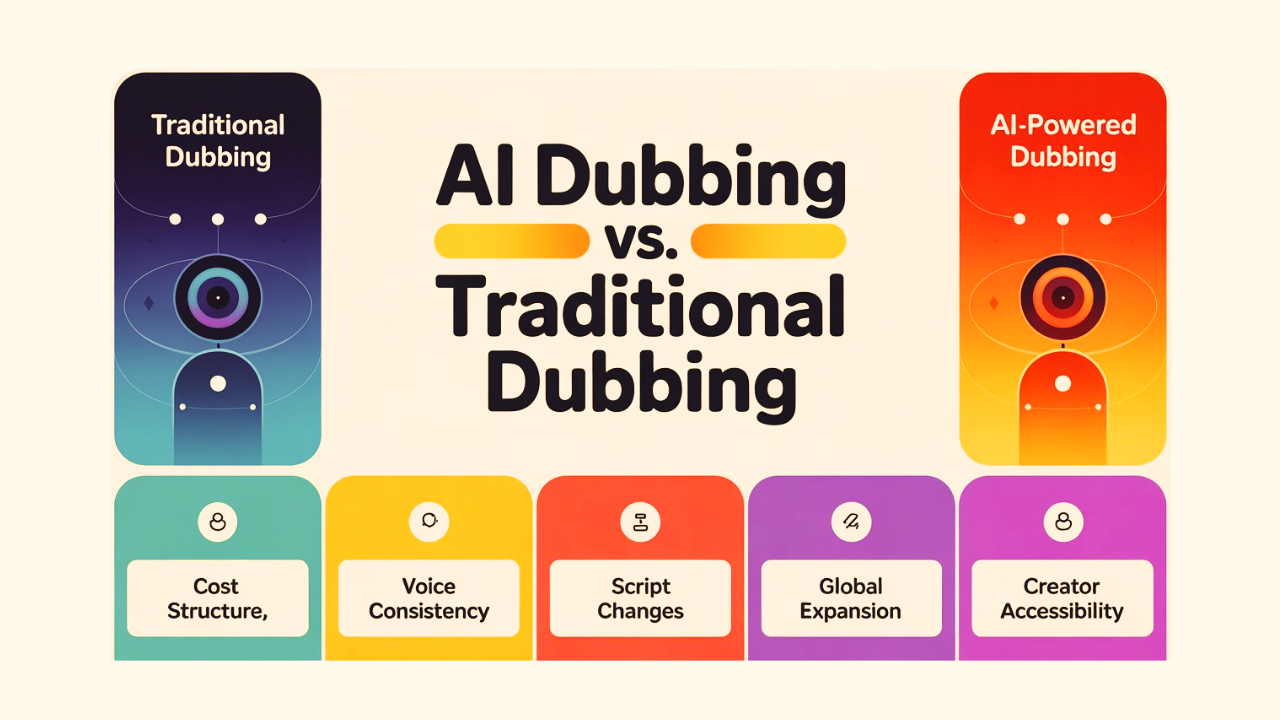
The numbers make the case clearly. Here is how AI-powered dubbing compares to traditional studio dubbing across the key factors that matter to video creators:
💰 Cost Structure: Traditional dubbing needs a studio, actors, and editors, while AI dubbing works on a simple subscription or per-minute cost.
🌍 Scalability: Traditional dubbing handles one video and one language at a time, but AI can process multiple videos and languages at once.
🎙️ Voice Consistency: Traditional dubbing may vary by actor and region, whereas AI keeps the voice consistent using voice cloning.
✏️ Script Changes: Traditional dubbing requires full re-recording, while AI lets you edit text and regenerate instantly.
🚀 Global Expansion: Traditional dubbing is slow and resource-heavy, but AI makes global reach fast and low-risk.
👤 Accessibility for Creators: Traditional dubbing needs big budgets, while AI dubbing is affordable even for solo creators.
Conclusion
AI-powered dubbing is shifting from simple translation to a broader content transformation strategy.
It reduces production costs, speeds up workflows, strengthens brand identity, and makes global audiences more accessible. For early adopters, the benefits compound over time, including better scalability, consistent output, stronger engagement, and a competitive edge.
Tools like VidScribe allow businesses to localize content at scale and reach audiences beyond their primary market. Whether you're just starting or scaling an established channel, AI-powered dubbing gives you the tools that were once reserved for Hollywood studios.
Language should no longer be a barrier to reaching global audiences. Choose a tool, localize your content, and expand into new markets without rebuilding your production process.
FAQs about the Benefits of AI-Powered Dubbing
Q: Is AI-powered dubbing quality good enough for professional content?
A: For standard narration and explainer content, top AI-powered dubbing platforms will produce voice quality that is almost identical to that of professional human voice actors.
For highly nuanced emotional content such as dramatic films or stand-up comedy, a hybrid model (AI + human review) is recommended to ensure cultural and emotional accuracy.
Q: How long does it take to dub a 10-minute video with Al?
A: Most AI-powered dubbing platforms process a 10-minute video in 15 to 60 minutes, depending on the number of target languages and the complexity of the audio. Some platforms offer near-instant dubbing for straightforward projects.
Q: Is AI-powered dubbing legal for YouTube?
A: Yes. In fact, YouTube has launched its own internal AI dubbing tools to encourage creators to go global.